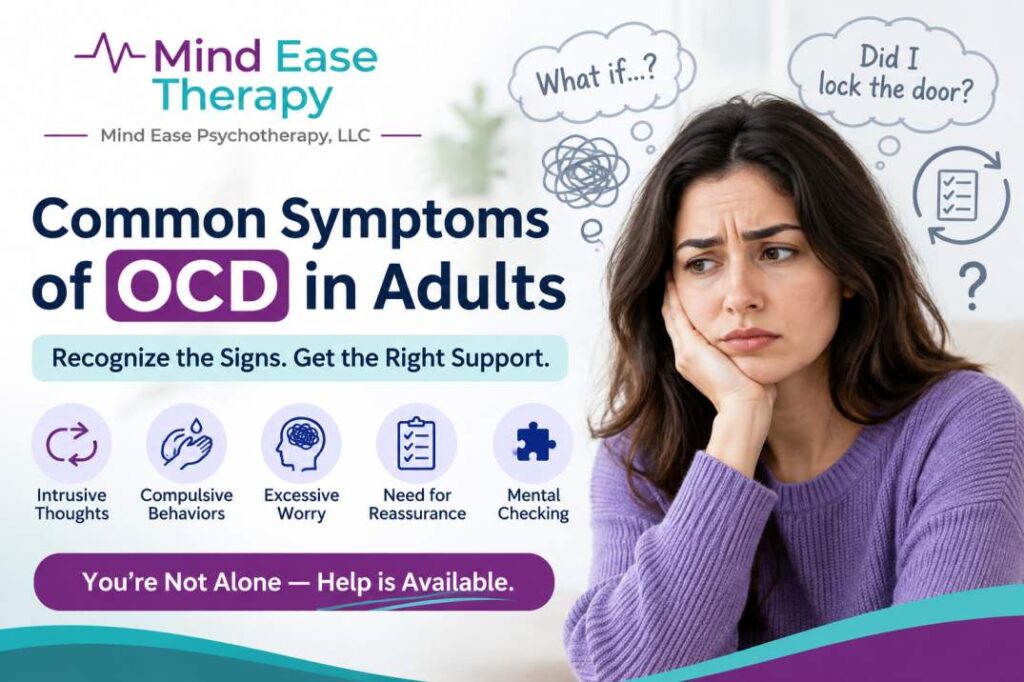
The common symptoms of OCD in adults are obsessions and compulsions. Obsessions are unwanted thoughts, images, or urges that keep coming back and cause distress. Compulsions are the things you feel pushed to do, in your body or in your head, to calm that distress. Together they usually eat up more than an hour a day and get in the way of work, relationships, or normal routines.
Here is the part that surprises many people. Most adults with OCD know their fear is bigger than the real risk. Knowing it does not help much in the moment. The fear still feels urgent, and the ritual still feels necessary.
What Are the Main Symptoms of OCD in Adults?
OCD runs on a loop. An obsession shows up and anxiety spikes. A compulsion follows and brings a short wave of relief. That relief teaches your brain the ritual was needed, so the obsession comes back harder next time.
You can have obsessions, compulsions, or both. Clinicians note that most people have both, although one can be much more noticeable than the other.
A few things set OCD apart from everyday worry:
- The thoughts feel intrusive and often clash with who you are.
- The rituals bring no real pleasure, only brief relief from anxiety.
- The pattern repeats day after day instead of passing.
Common Obsessions in Adults
Obsessions can attach to almost any fear, but a few themes appear again and again.
| Obsession theme | What it can sound like | What people often do about it |
| Contamination | “I touched that handle. I could get sick or make someone else sick.” | Wash, clean, avoid surfaces |
| Harm or responsibility | “What if I left the stove on and someone gets hurt?” | Check locks, appliances, driving routes |
| Symmetry and order | “This feels wrong until it lines up exactly.” | Arrange, repeat until it feels right |
| Unwanted violent or sexual thoughts | A sudden disturbing image that clashes with your values | Mentally review, avoid, seek reassurance |
| Religious or moral doubt | “Did I do something unforgivable?” | Pray in set patterns, confess, mentally check |
Clinical guides also list fear of mistakes, the need for certainty, and aggressive or sexual thoughts among the usual themes.
One point matters here. Having a disturbing thought does not mean you want to act on it. In OCD, the thought hurts precisely because it goes against what you value.
Common Compulsions in Adults
Compulsions are the actions people use to cancel out an obsession. These are the ones you will hear about most:
- Washing, showering, or cleaning far more than needed
- Checking locks, switches, or appliances again and again
- Arranging items until they feel right
- Counting or repeating actions
- Asking other people for reassurance over and over
Reassurance seeking is easy to miss, even for the person doing it. A psychologist interviewed by Insider explained it as reaching for an outside source to get certainty when doubt shows up. Everyone does this now and then. The difference in OCD is how repetitive it becomes. Some adults also describe long routines before leaving the house that make them late.
Can You Have OCD Without Visible Rituals?
Yes. Many adults do their compulsions entirely in their heads. These mental compulsions can include silently repeating a phrase, replaying a past event to check whether you did something wrong, praying in a fixed pattern, or counting in your mind. Some sources call this “pure obsessional” OCD.
It is easy to miss because nothing shows from the outside. A lot of distress can go completely unnoticed by the people around a person with OCD. Fighting the thought does not help either. Trying to push intrusive thoughts away can make them feel even more persistent.
How OCD Affects Daily Life
The effects on daily life are often easier to see than the thoughts behind them. Adults with OCD commonly notice:
- Rituals that make them late or take up hours
- Trouble stopping even when they want to
- Rising distress when a routine gets interrupted
- Avoiding places or situations that set off obsessions
NIMH also notes that people with OCD may avoid trigger situations or turn to alcohol or drugs to cope.
Low mood is common too. Harvard Health points out that people sometimes bring up feeling depressed instead of describing OCD symptoms that feel embarrassing. A minority of people with OCD also have tic symptoms now or have had them in the past. These overlaps are one reason a proper evaluation matters.
Is It OCD or Just a Habit, Worry, or Perfectionism?
Plenty of people double check a lock or like a tidy desk. That alone is not OCD. The difference comes down to three questions.
- Control. Can you stop the thought or behavior when you try?
- Time. Does it take more than an hour a day?
- Impact. Does it cause real distress or interfere with your life?
Liking order is a preference. Being unable to leave the house until a ritual feels complete is a symptom. Only a licensed professional can sort this out, because several other conditions can look similar.
Can OCD Start in Adulthood?
Yes, though it is less common. Sources vary on the details. Harvard Health says most people have their first symptoms before age 25, and symptoms usually do not start after 30. Other medical sources say onset after age 35 does occur.
The practical takeaway is simple. OCD usually begins earlier in life, but it can first appear in adulthood, and it often goes unrecognized for years. Symptoms can also change shape. Someone may start with checking and later develop contamination fears, since OCD symptoms can shift in focus or intensity over time.
When Should You Seek Help?
Get evaluated when thoughts or rituals take up real time, cause distress, or start limiting your life. You do not need to wait until things feel severe. Harvard Health notes that OCD rarely goes away on its own, and getting help sooner can lessen its impact.
Treatment works for many people. One well known option is exposure and response prevention, a therapy that helps you tolerate the anxiety from obsessions without acting on the compulsion. Medication is another route. NIMH explains that antidepressants used for OCD often require higher doses than for depression and can take 8 to 12 weeks to work. There is no cure, but treatment helps people manage symptoms and live full, active lives.
If you ever have thoughts of harming yourself, contact a crisis line or emergency services right away. In the U.S., you can call or text 988.
Frequently Asked Questions
What are the first signs of OCD in adults?
The first signs are usually repeated doubts, rituals that take longer than they should, and efforts to avoid certain triggers. You may also notice you need constant reassurance or that you replay thoughts in your head. Because much of this happens privately, many people go unnoticed for a long time.
Are intrusive thoughts always a sign of OCD?
No. Many people have odd or unpleasant thoughts now and then. It points toward OCD when the thoughts keep returning, cause strong distress, and lead you to perform rituals or avoid things to cope.
Can you have OCD without compulsions?
Some people have few visible rituals, but they usually still have mental ones, such as reviewing, counting, or praying in set patterns. This is often called pure obsessional OCD, and a clinician can help you identify it.
How many hours a day do OCD symptoms last?
Medical sources commonly describe symptoms as taking more than an hour each day and interfering with daily life. Some people spend far longer.
Is OCD just being neat or organized?
No. Neatness is a preference you can drop when it is inconvenient. OCD is driven by distress and an urge you cannot easily resist.
How common is OCD in adults?
NAMI reports that about 1.2% of U.S. adults have OCD in a given year.
Can OCD go away on its own?
Rarely. Harvard Health says OCD seldom disappears without treatment and can last for years. It is also common for people to live with symptoms for 5 to 10 years before seeing a psychiatrist.
How is OCD diagnosed?
A clinician makes the diagnosis. According to Penn Medicine, it is based on an interview with the person and family members, along with a physical exam to check for physical causes and a mental health assessment to check for other conditions. You cannot reliably diagnose yourself from an article.
Is OCD treatable?
Yes. Therapy, medication, or both help many people reduce symptoms and get their time and energy back. Results vary from person to person, so a clinician can tell you what to expect in your case.
Conclusion
The common symptoms of OCD in adults are intrusive obsessions and the compulsions, visible or mental, that follow them. A worry or a habit does not make it OCD. What defines it is the loss of control, the time it takes, and how much it disrupts your life.
This article is general information and cannot diagnose you. If any of this sounds familiar, a licensed clinician can assess it properly. Mind Ease Psychotherapy LLC offers online OCD therapy for obsessive thoughts and compulsive behaviors, and you can book a session through their website.